
This year — 2026 — has been completely bonkers for science and research, and it isn’t even over yet!
A small recap of how the world has shifted beneath our feet recently:
ICLR 2027 has more (abstract) submissions than all of the years combined
A single-person biotech, Mithril Medicine, had a successful exit
It’s clear that the sciences are going through a period of massive acceleration.
Indeed, I have personal experience of this. Recently, with the use of AI, I discovered two exoplanet candidates in our galaxy (despite being no astrophysicist) and new evidence on the “hot mitochondria” debate (despite being no biologist).
Would this have been possible in early 2026? No.
What does it imply for 2027? Well, we want to find that out.
Taking a bet on acceleration of knowledge
Two months ago, I wrote about shifting Lossfunk’s focus from AI research to applying advances in AI to accelerate progress on big open questions such as those of life, minds, and universe. Quoting the TLDR again:
We’re broadening our scope because we believe the scarce human contribution is increasingly choosing and framing important problems, while AI handles more of the execution.
Those problems exist far beyond AI research, which is what we started with but is now increasingly being automated. Hence, we’re prioritizing working with high-leverage people taking on important but under-defined problems and mysteries.
Over the last few weeks, we experimented with using AI to accelerate science. This included:
Personal experiments by our researchers in multiple fields
Across various fields such as biology, consciousness, self-driving cars, agent swarms, theoretical deep learning and law
Working with academics to see how far AI can accelerate their research projects
We got inputs from physicists, neuroscientists, biologists and theorists
Getting inputs from our residents (who’re mostly builders and startup founders) on what kinds of acceleration they’re seeing
We’re not new to AIxScience or automated research. Back in 2025, before the field even had a proper name, we had finished writing a report titled ‘Why LLMs Aren’t Scientists Yet: Lessons from Four Autonomous Research Attempts’. Then in mid-2026, we co-organized one of the first conferences for AI scientists.
Along the way, we released a harness for automated research, measured research taste in AIs and built an AI mentor for research. Our past residents have also launched a number of startups related to acceleration in science and research: AutoScience (Nilesh), Mandrake Bio (Tanay), Litefold (Anindyadeep), Neuropeek (Sohan), and Archgen Labs (Hari).
Given what we’re seeing out there and our own comparative advantage, I think it’s time to go all in! Hence, we’re betting on accelerating knowledge as our research focus, which we think is a crucial piece of the puzzle if we are to create a world of abundance.
Accelerating knowledge is a good thing
In my recent essay on recursive self-improvement, I talked about a positive future scenario with AI where we have enough abundance in the world for everyone to live like a rich person.
Getting there requires concerted effort on multiple fronts, and given that Lossfunk is a small, privately funded research lab, we decided to focus on the acceleration of knowledge bit.
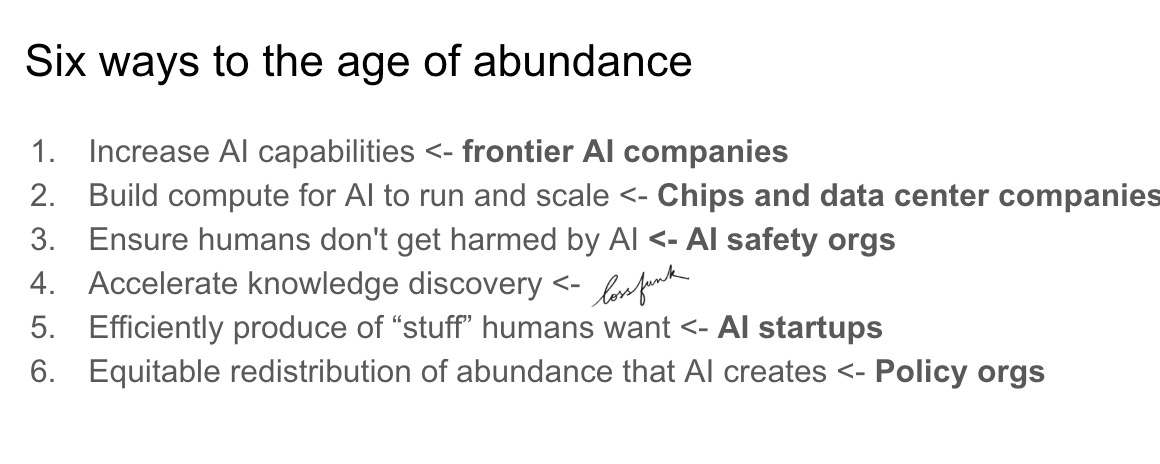
So while we understand the risks associated with loss of control with advanced AI, it’s something that frontier labs and hundreds of other AI safety orgs are best placed to focus on. We personally want to focus on the creation of new knowledge in the world, which could then be used for new inventions and discoveries in the future.
What does it mean to accelerate knowledge?
Our focus on accelerating knowledge is manifesting in the following three themes:
Accelerating frontiers of knowledge with AI assistance: tackling big questions in consciousness, nature of reality, language and its origins, life and its origins, brains and intelligence, patterns and computation, health and biology, energy and compute efficiency, physics and hardware.
Building a science of automated research: research taste, operationalization (of fuzzy problems), science of verification, experiment design and decision theory, evidence synthesis and literature sweeps, ensuring rigorous claims, systems for automated research, verifier gap engineering.
Democratizing the acceleration of knowledge: public-facing talks, workshops, competitions and platforms; metascience, collaborations with academia and industry for AIxScience, verifying and correcting current knowledge, communicating new discoveries, citizen science with agents, new institutions for knowledge creation, public commons for AIxScience.
If any of these themes or sub-themes seem exciting to you, consider applying to join Lossfunk either as a full-time researcher, fellow or part-time resident (application form on lossfunk.com).
We’re thankful to our compute partners who make this research possible: AWS, GCP, JarvisLabs, Sarvam and OpenAI.