
This month, it’ll be 2 years of Lossfunk, an AI lab I started after selling my previous company Wingify. Two years is an eternity in the AI space. LLMs have gone from barely being able to solve high school math problems to now solving famous conjectures; and simultaneously we’ve seen a shift from autocomplete within IDEs to one-shot prompting of entire apps.
TLDR:
We’re broadening our scope because we believe the scarce human contribution is increasingly choosing and framing important problems, while AI handles more of the execution.
Those problems exist far beyond AI research, which is what we started with but is now increasingly being automated. Hence, we’re prioritizing working with high-leverage people taking on important but under-defined problems and mysteries.
We’re also experimenting with what labs of the future could look like, by rethinking our outputs beyond papers.
We obsess about the future, and keep thinking about the asymptotes. Hence, looking at the reality of AI capabilities today, we’ve decided to make a few changes to how we work.
Expanding the scope of the lab beyond AI
Raising the bar of human researchers we hire
Rethinking our outputs beyond publications

Expanding the scope of the lab beyond AI
At Lossfunk, we want to work on problems that are out-of-distribution for traditional institutions such as academia, industry or VCs. These are problems that are not yet fully legible but could be hugely consequential if solved.
Such problems are typically overlooked by committees as they seek to fund plans whose outputs can be clearly defined upfront. Because Lossfunk is driven by an individual (me) who is self-funding its activities, we’re able to fund problems and mysteries that will be passed on within traditional structures.
When we had started, our focus was on unsolved problems in AI research such as adaptation, creativity and sample efficiency. We’re still interested in these problems, but now our scope has broadened to include many other areas we’re naturally finding ourselves orbiting around during our lunch time talks.
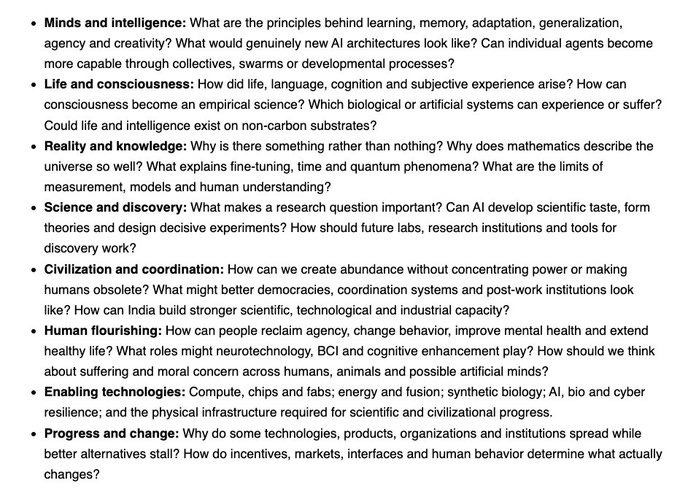
As you can see, this list is mostly everything under the sun. The one common theme amongst the topics is that these are unsolved mysteries and problems that are a bit fuzzy but deeply important.
One important reason why we’re moving away from just AI research is that we find that AI research is increasingly automatable, limiting the contribution of a human researcher in the final output. We have significant first-hand experience of this. We organized a Conference for AI Scientists 2026, developed an autoresearch system, and had an autoresearch round in our hiring process.
Our conclusion is that current AI tools can autonomously produce workshop level papers in AI/ML, and soon will be producing conference or journal level papers in many scientific fields. Combine our first hand experience with the fact that AI/ML conferences now get ~50,000 paper submissions, we decided it isn’t worthwhile to focus exclusively on AI research.
We believe that the opportunity cost of not using AI to attack other outstanding fields is high and hence we wholeheartedly embrace AI workflows to accelerate our work; it’s just that we want our work to be directed at problems beyond just AI research as we believe AI research will have less and less need for human input.
Raising the bar of human researchers we hire
Like many others in the industry, we see entry-level work already automatable. The AI employability gap for young people had grown to 19% (and apparently, this is the only age group seeing a decline).
An experienced human today faces a choice of either using Codex/Claude Code to get his work done, or to work with a junior human. Increasingly, these AI tools do a better, faster, cheaper job of entry-level work (which is typically so codified that an agent might do it better). Senior, experienced people are today highly-leveraged; they can easily do work of 10 people by using agents in their workflow. However, this does mean fewer opportunities for juniors to get trained.
We believe that the future belongs to those who’re highly autonomous, comfortable using tens or hundreds of agents, can translate real world ambiguity to precise instructions for AI and have enough experience to verify output generated by agents.
This is why we’re:
Introducing a sabbatical program (for exceptional, experienced people)
Expanding our fellowship program (for people who have some experience), and
Restarting residency (6 week cohort for deeply curious builders)
Pausing internships (for undergrads)
We’d still hire exceptional undergrads via our fellowship program, but our focus will be on enabling experienced, high-leverage individuals to take on ambitious problems. Our hiring process prioritizes those who can work autonomously on ambiguous problems and produce worthwhile outcomes.
By the way, we’re quite concerned about the broader implications of this decline in hiring of junior people — we’re concerned about how they will get trained and how they will ever acquire skills required to do a real world job. OpenAI today published that they now have an internal automated AI research intern, and we expect the trend to accelerate not just in AI research but most domains out there.
My advice to young people reading this post is to extensively use AI and AI-generated simulations to understand what the real world needs and what unique contribution they could make in a world swarming with agents. Every young person should ask themselves: what is my comparative advantage in an increasingly automatable world? This paper Some Simple Economics of AGI has an entire section on recommendations for individuals and we strongly encourage going through it.
Rethinking our outputs beyond publications
Over the last 2 years, we’ve been able to produce research that got accepted into A* conferences and workshops such as NeurIPS, ICML, and ICLR. However, this emphasis on papers seems increasingly archaic. Current process of academic publishing has many flaws: it incentivizes only positive results, pushes for manufactured novelty, has a widespread replication crisis, doesn’t allow for the messy process of research to be documented, and leaves the fate of work hanging on a few peers.
AI can generate papers at such a rate now that peer-review will get overwhelmed, and we will see the way science happens change dramatically over the next few years.
We’re interested in doing experiments on what kinds of outputs a lab should produce. Academia and peer review serve a useful function of giving detailed feedback that improves the quality of work, but we feel a focus on publications sets up perverse incentives that give too much emphasis on the final output. Hence we’ll start experimenting with different types of outputs beyond papers. These will likely include:
sharing raw AI-chat transcripts
releasing instructions for agents to replicate or extend our work
producing actual libraries/software that works, instead of merely publishing ideas
circulating our work via talks and in private groups
running competitions in verifiable domains
Wherever it is relevant, we may still submit a paper to a conference, journal or a workshop, but this will no longer be a primary emphasis or a measure of impact. Instead, we intend to run experiments and make sense of what the future of science may look like.
The way I see it, Lossfunk is a meta-experiment that enables many more experiments. Lossfunk is an experiment about what orgs of the future could look like, how third spaces should be built, how patronage should be done, and how to harness the latent potential of a nation.
Lossfunk is a vehicle to aggregate and support deep thinkers and technical builders who’re not afraid to go wherever their curiosity takes them. So if you’re that kind of person or work at an organization that values out-of-distribution projects as a viable path to the future, Lossfunk would be a great partner to you.
After all, we’re a lab for time travellers and would love to have co-riders for an enjoyable journey into the future.
I really like this direction especially the the sharing of prompts that make it possible to explore the future of citations
where we can do fine grained attribution to what role the human and AI played
whatever the future academia is it can do better in setting the incentives towards truth seeking
rather than journal papers/ideas the outputs can be working prototypes since actuation is cheap
Very impressive. Excited to see what lies ahead.
There are a few "AI-ish but beyond efforts" on progress (https://rootsofprogress.org/), on truth (https://www.cosmos-institute.org/), on alignment adjacent (https://www.mindthefuture.info/)